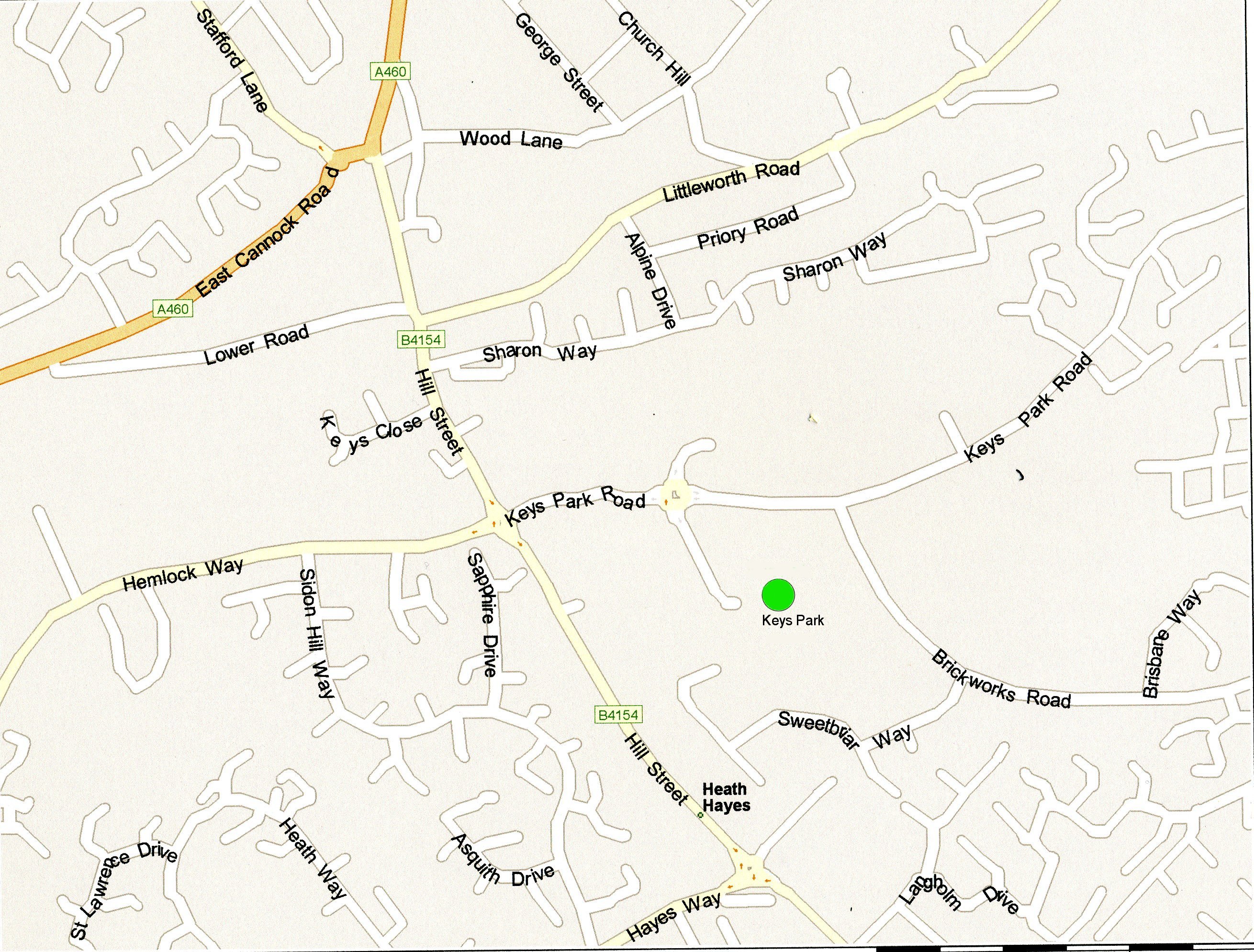
 Map of location & approaches to Keys Park
(click on map to enlarge)
Map of location & approaches to Keys Park
(click on map to enlarge)2003 QUARTERLY MEMBERS MEETING
The First Quarterly Meeting (March)
The First Quarterly meeting of the members of the CCMHS was held at the Museum of Cannock Chase Valley Rd, Hednesford (the site of the old Valley Colliery) at 3.00pm
Mr Jack Sunley the Chairman of the CCMHS introduced the speaker Mr Jack Evans a gentleman well known throughout this area by almost everyone who has ever had any contact with the mining industry. Mr Evans gave a riveting account of his working life within the Cannock Chase Coalfield. He told of being a Birmingham doctors son who wanted to be a coal mining engineer. How he entered into university and after a short while realised his course was engineering, he asked when they would get to the mining side and was promptly sent to Hilton Main to gain experience. From here he worked his way through the ranks was noticed and promoted to Colliery Manager at the Fair Lady. He was then given Lea Hall colliery and managed it from its opening to it first million tons, promotion followed promotion until he eventually reached the position of Area Director of the BC Central Area. Despite all this Jack Evans has never lost his roots or where he came from throughout all his career. He told it as it was the good, the bad and the ugly bits. The membership present thoroughly enjoyed this our first speaker although it must be said that the attendance was shall we say a little disappointing. The chairman thanked Mr Evans for giving his time for the Society and the members and guests showed their appreciation in the usual way
The Second Quarterly Meeting ( June)
The second Quarterly meeting of the members of the CCMHS was held at the Museum of Cannock Chase Valley Rd, Hednesford (the site of the old Valley Colliery) at 3.00pm on Wednesday 18th June 2003. The guest speaker was Mr Mark Tweedy from the Foxfield Railway Society North Staffordshire
Mr Jack Sunley the Society Chairman welcomed Mr Tweedy and introduced him to the members he told the audience that he always seemed to meet Mark Tweedy at fund raising events. He then handed over to Mr Tweedy who with sleeves rolled up and hands that had just finished a shift possibly on an old steam boiler, he launched into what turned out to be a most interesting, very informative and amusing tale. The narration was about Mr Tweedy's involvement with the Foxfield project which he joined in 1969 to the present day. He had at the start offered to take questions as he when along and also advised the audience to stop him when they had heard enough. It has to be said that the speaker went well past the hour and no one present seemed in the least bothered or bored. In fact if the chairman had not made the observation that the museum should have closed at 4.00pm and it was well towards 5.00pm we could well have been there a lot latter. The chairman closed the meeting by thanking Mr Tweedy on an excellent talk and the floor showed their appreciation in the usual manner.
The Third Quarterly Meeting
The 3rd Quarterly meeting of the members of the CCMHS was again held at the Museum of Cannock Chase Valley Rd, Hednesford (the site of the old Valley Colliery) at 3.00pm on Wednesday 17th September 2003. The guest speaker was Mr Brian Worthington of Joy Mining Machinery Manufactures Pinxton Works in Nottinghamshire.
Mr Len Fletcher a former British Coal Group Mechanical Engineer for the area welcomed Mr Worthington (himself an ex-British Coal employee) to the Society and introduced him to the members and guest. He told the audience a little about Mr Worthington having known him for the last 15 - 20 years. He then handed over to Mr Worthington who with the add of a slide show presentation began his talk on the latest Modern Heavy Duty Mining Machinery used in coal and various other mines. The audience sat memorised as Mr Worthington told of the early beginnings of the Joy mining company started by Joseph Francis Joy who was born in 1883 He work in the mines and held every conceivable job from pumper to superintendent and in 1916 his first Joy Loader was delivered and used in Pittsburgh. He then mapped the progress through to modern times and showed slides and videos of old and new machinery in the development stages, on test and in use in various mining applications. He went into some detail of the testing and monitoring at all stages that takes place within Joy and also when the machinery be it coal cutting equipment, roof supporters or face coal clearance systems was installed at the mines.
The figures he produced on tonnages from the worlds coal fields were staggering and in particular one district in outer Mongolia China called Shenfu-Dongsheng it was astounding to the people in the room were a million tons per year was the magic figure.. Annual production from Shendong’s mining operations reached 37 million tonnes (40.7 million tons) in 2001 and is planned at 50 million tonnes (55 million tons) this year this from 2 mines. It must be added that these tonnages are achieved from 5 - 6 metre coal seams retreating 38 metres per shift, were British mines worked mainly 2.8 - 4 metre seams and a retreat of 5 - 6 metres was an achievement.
The size of the equipment was colossal compared with the equipment in use when we finished production in 1993 on Cannock Chase at Littleton Colliery.
Fourth and Final Quarterly meeting 2003
The LAST quarterly meeting OF THE CANNOCK CHASE MINING HISTORICAL SOCIETY FOR THIS YEAR 2003 with A guest speaker took place at: -The Museum of Cannock Chase (the old Valley Pit), Valley Road, Hednesford on Wednesday 26th November 2003. The subject was The Roll of Her Majesties Inspectorate in Mining and the talk was given by Mr Gary Goodlad Her Majesties Chief Inspector of mines. Mr Len Fletcher introduced Mr Goodlad to the floor with a brief out line of his qualifications and career to date and most impressive it was. The attendance was very good with 26 members attending out of the membership of 35 present. Mr Goodlad with the aid of computer graphics talked for just over an hour on the re-structuring and work of HM Inspectorates present roll in coal and other mining including opencast mining. At the conclusion of the talk questions were taken from the floor and Mr Brian Rollins retired Chief Area Surveyor thanked Mr Goodlad for giving up his most valuable time to talk to us.
_________________________________________________________________________________________________________________________________
The CCMHS first AGM
As advertised the Society held its first annual general meeting at the Museum of Cannock Chase on the afternoon of Monday 23rd December 2004. A total 14 members attended the meeting at which the previous 12 months accounts were submitted and received and the previous 12 months business of the Society was reported on. Also at the meeting two founder members of the CCMHS announced that they would be standing down from the posts that they currently held. These were Mr Jack Sunley the Chairman who had been a driving force along side Mick Drury in the initial formation of the Cannock Chase Mining Historical Society and the writing of the book on the Cannock Chase Coalfield and Mr Maurice Davies the Treasurer who is also the author for the Rescue section of the book. Both gentlemen stated that now that the project was well underway, they wished to retire from office and and at their time of life take a back seat. The Society thanked them for all their hard work and wished them well and hoped that they would continue to support the CCMHS. The chairman then informed the members that committee recommend that the Chairman's vacancy be filled by Mr Brian Rollins (himself a founder member and committee member and author), this was proposed, seconded and carried by the members present. It was also recommended to the members that Mr Arthur Renhard be accepted to the post of Treasurer this was also proposed, seconded and carried by the members present. In any other business Mr Alan Dean put it to the floor that Mr Jack Sunley the outgoing Chairman be offered the position of Life President of the Cannock Chase Mining Historical Society, the members accepted that this was an excellent gesture and it was proposed, seconded from the floor and passed by the membership present at the meeting. Mr Sunley said he felt very honoured and would gladly accept the position. With no further business arising the chairman closed the meeting and wished the members a safe journey home.
__________________________________________________________________________________________________________________________________
First quarterly meeting of 2004
The first quarterly meeting with a guest speaker was held at The Museum of Cannock Chase (the old Valley Pit), Valley Road, Hednesford. The meetings advertised guest speaker MR PETER HETHERINGTON Head Engineer for UK Coal was unable to attend due to other commitments within UK Coal but in his place he sent Mr Kevin Sabin, Operational Support Manager UK Coal Plc, Mr Wyn Griffiths, Coal Face Design Engineer UK Coal Plc and Mr Neil Clempson, Managing Director Control Systems Ltd. The meeting was opened by the incoming Chairman Mr Brian Rollins, he handed over to Mr Len Fletcher who introduce the speakers to the meeting. Kevin Sabin with the aid of computer graphics then talked the group through the short history of UK Coal from its beginning as R J B Mining to its present level of production as UK Coal. His talk covered a wide spectrum of subjects all of which have affected and changed the way that coal has been produced over the last 10 years and will be produced in the future. These include costs, structuring manpower, industrial relations, technological advances and closures of collieries. The content was such that there was far to much information to retell on these pages. The two main factors which seem to have awed the audience was the cut in manpower to to run the pits a total of 450 men per unit and the advances in size and and technology of the equipment. Kevin then handed over to Wyn Griffiths who showed the members slides and 3d computer drawings of the past and present coal getting equipment. Finally Kevin Sabin with the aid of Mr Neil Clempson made a live computer link form Hednesford via the telephone system to Daw Mill Collieries control monitoring system. This provide the members with a live ON SCREEN second by second blow of what was happening with the underground equipment and also the surface coal clearance scheme. Showing the journey of the coal from face to stock pile in this fully COMPUTER controlled mine. Daw Mill is the largest single production unit within UK Coal Plc and started life as a single ventilation shaft for the then Dexter Colliery. Coal was first brought up the shaft in 1965 and in 1968 a second shaft was sunk, in 1982 a surface drift was added. The Warwickshire Thick seam (this seam is the only seam mined at Daw Mill) is estimated to contain 39.3 million tons of coal reserves, with a further 43.1 lying outside the existing southern boundary at a depth of over 1000m and thickness of 4.0m. This year Daw Mil will make history by working the longest longwall face ever worked by the colliery with a seam extraction of 5m the largest ever taken in the UK. The members then fired the usual round of questions at the speakers and Mr Mick Drury thanked the visitors for an excellent and interesting presentation he pointed out the vast differences of coal extraction as he knew it in 1993 at the closure of Littleton Colliery, to the present state of the industry today. The chairman closed the meeting and wished all a safe journey home.
The second quarterly meeting was held at The Museum of Cannock Chase (the old Valley Pit), Valley Road, Hednesford, on the evening of the 21st June the meeting. The meeting commenced at 7.00pm with the talk beginning at 7.30pm. The guest speaker on this occasion was the CCMHS Chairman MR BRAIN ROLLINS, his talk entitled The Effluent Disposal Scheme at Walsall Wood Colliery after it's closure or as Brian puts it "Coal to Crap" was a very interesting and informative talk. It was also a bit of an eye opener with quite a few facts being revealed about the lack of real control that was exerted by the local authorities on the actual type of effluent being deposited down the Walsall Wood shaft. Brian was at that period of his career Chief Area Surveyor for the NCB Western Area based at Staffordshire House Stoke on Trent and this dropped him right in the deep end, he know the underground workings of Walsall Wood Colliery well as he had been head surveyor there before his move to Headquarters. He was made representative for British Coal who although they had shut and disposed of the Colliery many years earlier were still responsible for it. This meant that Brian was first in line for the Crap in he title. He dispelled the myth about the first explosion after the dumping of the effluent began, it was in fact an implosion down into the mine which took the conservatory type bubble building (constructed at the shaft top to stop the awful stench that was emerging out of the workings) down the mine. He also related how the only explosion in the shaft was caused by two workmen on duty at the shaft top lowering an extension light down the shaft to see if they could found out why the effluent was not seeping away into the workings. The extension lamp of at least 100 yards long was lowered down the shaft with the light switched off when the men though they were far enough down the shaft the lamp was switched on, it was concluded the bulb smashed and the resulting shorting, caused gasses in the shaft to explode blowing the pit top cover of tin and asbestos sheet over most of Brownhills and Clayhanger. It was good to be told that no heavy materials were ever dumped at Walsall Wood but it is also quite disconcerting to also be told that nobody really knows what actually was dumped. The talk was in the eyes of the CCMHS a success although the attendance was down (as on the evening of this quarterly meeting England played their final game in the Euro 2004 competition) we managed to wrestle 12 people away from ITV & BBC television quite a coupe we thought for our miniscule event. The CCMHS would like to thank Mr Brian Rollins for a very interesting and informative evening.
The 3rd quarterly meeting Monday the 20th September featuring the talk by Ken Edwards on the Cannock and Rugeley Colliery Company Ltd was the best attended yet with 32 members and guests present, out of a membership of 44. Ken who had not attempted this paper before gave an excellent account of himself and the talk was most interesting. It was packed with facts and figures, slides and of course the history of the Cannock and Rugeley Company. Ken who is the author of this chapter and also the Fair Oaks and Brereton chapters of the society book, kept it interesting without giving to much away and so revealing the complete story of the Company, as they say he wet their appetites. There was plenty of questions and a few recollections from the people in the room all in all a very well presented talk. If you want to know more about the Cannock and Rugeley Company or any other Colliery Company, then buy the Book ! Its out in September 2005 you can pre-order without obligation to buy, as the price of a book has not yet been agreed upon.
_______________________________________________________________________________________________________________
Quarterly meetings of 2005
The First Quarterly meeting was in January and a slide show was given by David Battersby on the old colliery's of the Cannock Chase Coalfield and excellent attendance and a superb evening Mr Battersby has been asked to give another such show.
Second Annual General Meeting
The 2nd Annual General Meeting of the Society held in February was attended by 12 members, the reports of the individual officers of the Society were read and accepted by those present. No new nominations for the committee were received from the floor therefore the officers of the Cannock Chase Mining Historical Society will remain in place until the next general Annual General Meeting in February 2006.
The second quarterly meeting The March quarterly meeting was a resounding success it was attended by 37 members (well done). Dennis Jackson gave an excellent history of the Coppice Colliery (Fairlady) Heath Hayes with many facts that were unknown to even people like myself who were born by it. Mr Joe Lander 96 years young was also in the audience he had worked there and changed the headgear in the 1950s for one from Norton Green. Dennis got so carried away with the occasion, that he had to cut short the history of Leacroft Colliery but all in all he gave a good account of its life story.
The quarterly meeting held on June 20th 2005 at the usual venue the Museum of Cannock Chase Valley Rd, Hednesford, Staffordshire was a great success and was again very well attended with an audience of 34 members and guests. The speaker Mr Ken Edwards gave a very interesting account of the history of the Brereton Colliery Company, Ken having started his working life at Brereton researched the Company for the book and was obviously very well informed on all aspects of its history.
2006 Q Meetings
The 3rd Annual General Meeting of the Society held in February was attended by 18 members, the reports of the individual officers of the Society were read and accepted by those present. New nominations for the committee were received from the floor as some officers were retiring and did not wish re-election the nominations were excepted and the new officers of the Cannock Chase Mining Historical Society will remain in place until the next general Annual General Meeting in February 2006.
The first quarterly meeting of 2006 was held on March 20th at the usual venue the Museum of Cannock Chase Valley Rd, Hednesford, Staffordshire the usual format applied the group met at 2.30pm and the talk began at 3.00pm sharp. The speaker on this occasion was Mr Alan Dean who gave an account of the history of the East Cannock Colliery Company Ltd. Alan went straight from school into the mining industry as a mechanical apprentice, spending 21 years at West Cannock No.5 Colliery were he reached the position of assistant mechanical engineer then the final 9 years of his career at Littleton Colliery specialising in shafts and winding. The talk lasted 1 hour 20 minutes and was delivered with the aid of excellent computer generated presentation on a projector kindly loaned by St Peters School Church Hill. The collieries history was told by Alan in some detail, starting in 1870 and ending in 1957 when it closed. It must be said that Alan coped very well at this his first public speaking event since leaving college in 1984. With such a large audience some 55 people, the largest yet at a Society talk it must have been quite daunting with many of the men present having worked at East Cannock, even these learned many facts that they never knew about their old pit.
The 2nd Quarterly meeting was held on Thursday June 15th at the usual venue the Museum of Cannock Chase Valley Rd, Hednesford, Staffordshire. The meeting started at 6.30pm and the talk began at 7.00pm sharp. The speaker MR PETER BARKER told the story of The Cannock Chase Colliery Company Ltd. Peter started work as an apprentice mechanic at Cannock Chase 3s and so had personal experience of the company and with the aid of a pictorial presentation gave a fascinating account of the way in which the company evolved, progressed and ended he also showed how contrary to belief some colliery companies really cared for the communities they spawned. He told how like many they provided places of worship but also this company provided leisure facilities and electricity to the district around its pits. The meeting was attended by 35 members and guests and we would like to congratulate Peter on providing a most successful evening.
The 3rd Quarterly meeting of 2006 will be held on Wednesday 6th September at the usual venue the Museum of Cannock Chase Valley Rd, Hednesford, Staffordshire. The meeting will start at 6.30pm with the talk beginning at 7.00pm sharp. The speaker on this occasion will be Mr TREVOR MATTHEWS telling the story of The HOLLY BANK & HILTON MAIN COLLIERIES. Trevor started work at Hilton Main in 1951 after graduating with a B.Eng (mining) from Sheffield University, he gained his Managers Certificate in 1958 after which his career took him to Mid Cannock, West Cannock No.5 and finally Littleton from were he retired as Assistant Manager. This talk promises to be a most interesting experience full of fascinating facts and anecdotes from Trevor's most varied experiences in the mining industry. Please make the effort to attend and make this talk as successful as the previous talks.
Remember our meetings are open meetings for members and guests in fact anyone interested in our mining heritage and local history, all are welcome to come along. ENTRANCE IS FREE.
FINAL QUARTERLY MEETING 2006
The final quarterly meeting of 2006 is on Tuesday 12th December, it will take the form of an informal coffee morning with mince pies and a film on coal mining at Hilton Main Colliery in 1950. The venue is as usual the Museum of Cannock Chase Valley Rd, Hednesford, Staffordshire the meeting will start 11.00am prompt, hope we see you all there (refreshments are free).
2007
The third quarterly meeting of the society takes place on Tuesday 3rd July at Keys Park Hednesford (home of Hednesford town football club) see map below. The meeting will begin at 6.30pm and the talk "An Explosive Experience" will given by Mr Malcolm Ingry commencing at 7.00pm sharp.
Please make a note that all our meetings this year will take place at the above venue due to the extensive building work being carried out at the Museum of Cannock Chase.
Map of location & approaches to Keys Park
(click on map to enlarge)
The third quarterly meeting of the society took place on Tuesday 3rd July at Keys Park Hednesford (home of Hednesford town football club) see map below. The meeting began at 6.30pm and the talk which started at 7.00pm was given by Malcolm Ingry. The talk was about Malcolm's experience dealing with explosives of which he has 40 years, dating from his time as a shotfirer/deputy down the pit to his work with the film industry. He took a packed house through a guided tour of all types of explosives and with the aid of a multi media presentation he showed the effects of each one on various materials. He then went onto explain how explosives are used to create the special effects we all love to see in the movies we watch the audience were enthralled with the effects Malcolm had created in 4 James Bond movies and in the Film Johnny English starring Rowan Atkinson. Then he explained how he had made the special effects in TV adverts, the one most people were conversant with was the "Sony Bravia" (click link to view) one with the paint exploding around the block of flats. He also showed the demolition that everyone loves to watch the blowing up of tower blocks and explained the ins and outs of the procedures to a total focused room of people. This was one of the societies most explosive evenings and the audience hung on Malcolm's every word. We thank Malcolm Ingry for his excellent talk and also the people who attended, 55 in all matching the attendance of the talk by Alan Dean, Malcolm has agreed to come back at a future date to give us another evening of explosions
The fourth and last quarterly meeting for 2007 of this society takes place on Monday 29th October 2007 at Keys Park Hednesford (home of Hednesford town football club) for directions to the venue see the map below.
The meeting will begin at 2.30pm and the talk will commence at 3.00pm sharp. The theme of the talk is "After the mines are gone" and it will given by Simon Reed head of the Coal Authorities Mining Hazards department.
The final quarterly meeting of 2007, was held on Monday 29th October 2007 and was attended by 36 members & non members.
The talk was very well received by those present as Simon Reed explained with the aid of a multi media presentation how the Coal Authority was still dealing with our mining legacy from the 19th & 20th century in all the old mining areas around the UK.
The extent of this mining subsidence is really quite alarming when you are shown the holes that have appeared in various residential sites around the country, in places such as front & rear gardens, playing fields, main roads and even beneath the fireplace in a house. It appears all the mines have not gone as the title of the talk suggested but are still causing the government head aches.
_________________________________________________________________________________________________________________
A.G.M
The 7th ANNUAL GENERAL MEETING of the Society took place on Monday 21st January 2009 at the Museum of Cannock Chase, Valley Road, Hednesford, WS12 1TD.
The meeting was chaired by M Drury and was well attended by the membership, no amendment(s) were made to the constitution, any member wanting a copy of the amended constitution should apply to the secretary at enquiries@ccmhs.co.uk they should include their membership number in the email.
The Chairman reported to the meeting that the society seemed to be going from strength to strength and had now published 13 books on the Cannock Chase Coalfield. He also added that the society was in demand for after dinner talks and school talks.
The treasurers report showed that the ccmhs finances were in a healthy state and in good sted to fund or ongoing projects. There were no retiring officers and no nominations for positions within the committee, there for the members present proposed and seconded that the committee members who were present at the meeting remain in post for the next 12 months.
Membership has remained stable at 96 members.
____________________________________________________________________________________________________
AGM
On 16th February 2010 ay 11.00pm the society held it's 8th ANNUAL GENERAL MEETING at the Museum of Cannock Chase, Valley Road, Hednesford. The meeting was very well attended by it's 6 officers and 33 of the ordinary membership.
AGENDA OF MEETING
1. Welcome and Apologies for absence.
2. Minutes of the previous AGM and matters arising.
3. To receive reports from the Officers.
4. To receive and approve the Annual Accounts.
5. To elect the Officers and Ordinary members of the Committee.
6. Future Events.
7. To consider any matter or proposal for which due notice has been given.
THE REPORT ON THE MEETING
Apologise were received from 13 members
The minutes of the last AGM were accepted as a true copy by the meeting as was the audited accounts of the society.
The services of the auditor were retain for the following 12 months.
The chairman Mr Peter Barker then gave the following report:
Chairman’s Report.
The chairman first reminded members that this year’s subscriptions were now due.
He outlined a summary of the Members’ Quarterly meetings that had been held and went on to itemise the following events with which the Society had been involved in the past year.
These included Society displays at the following events:
The Chase Wakes;
Harrison's Club Anniversary included a talk on explosives;
The Burntwood Heritage Anniversary;
The Bridgetown Book club;
The Family Weekend;
The Local History Weekend; and
The Walsall Wood Community memorials
The Chairman then went onto ask the same question that Mick Drury had enquired on earlier i.e. what was the progress of the last 2 remaining colliery books?
Mick Lucas explained that the West Cannock book was held up waiting for more pictures but is near completion. He is unable to comment on the Hawkins book.
Further activities were:
The prestigious lecture presented to The Newcomen Society by Alan Dean, substituting for Dennis Jackson.
Dedication of the plaque in memory of the disaster at Old Hednesford colliery: The site of which is on Hednesford Football Club.
The Christmas Coffee morning with films;
A talk to the Staffordshire Archaeological Society by Alan Dean;
School talks given by Mick Drury and a thank you letter from Norton Canes School; and
Society talks given to Staffordshire organizations by Dennis Jackson.
A very comprehensive list of our year’s work in which Peter paid tribute to the efforts of Mick Drury our former Chairman.
Future Events.
We shall be holding quarterly meetings during the year –
April – J.R.Mclean – Ron Bradbury
July – War camps of Cannock Chase – Ian Wyke
October – West Cannock Collieries – Alan Dean
50th Anniversary of the closure of the Brereton Collieries and the opening of Lea Hall Colliery in July 1960 will take place this year a service will be held in Brereton Parish Church on Sunday 11th July at 6.30 pm. There will also be a display of photographs etc at Brereton Parish Hall on Saturday 19th June presented by Ken Edwards.
Your existing committee has started preparatory work on a “Plaque Project” to encompass all major collieries from Lea Hall in the east to Hilton Main in the West. This is going to be a major project for which the society is hoping to obtain funding. We will keep you informed of its development.
Finally in thanking you for your support I would on your behalf thank Jack Sunley for the service he has given to our society since he feels the time is now right to step down from the committee, whilst still remaining Honorary President of the society – thank you Jack.
Election of Officers.
In accordance with the Constitution, all officers of the Society retired at this meeting. The following Officers were the elected:
Chairman - Alan Dean.
Vice Chairman - Peter Barker.
Secretary – Dennis Jackson.
Treasurer – Margaret Dean.
Membership Secretary – Alan Dean.
Other elected members: Harry Gibson, Malcolm Baker, Rod Spruce, John Ashley and co-opted Michael Lucas.
With no further business the meeting closed at 11.55am
Next AGM will be held in 14th February 2011
JULY 2010
The Members’ Quarterly meeting held on Tuesday day evening July 6th at the Museum of Cannock Chase was a most interesting and successful event. The speaker Mr Ian Wykes of Staffordshire County Council's archaeology department gave us a most riveting talk on the Great War Camps of Cannock Chase. Did you know that during the period from 1914 - 1918 as many as 50,000 military personnel of many nationalities were living and training for the conflict in France in 2 purpose built camps at Brocton & Rugeley. The talk was accompanied by many excellent photographs taken during the period of the time and also some taken as comparisons now. Many of us have walked miles around Cannock Chase and know very little of the activities that have taken place over the past 2 centuries. The meeting was attended by 28 members and friends.
2011
Cannock Chase Mining Historical Society
February 14th 2011
AGENDA
1.
Welcome and apologies for absence
3.
The Chairman’s report on the CCMHS
4. To receive the report of the annual accounts from the auditor Mr Cooper.
Also to approve his retention as auditor to the CCMHS for coming year 2011
5.
To approve the amendments to the Constitution of the Cannock Chase Mining
Historical Society as proposed by the committee. A copy of
these amendments having been supplied by post, to each paid up member.
6.
Retirement of the serving officers of the committee
7.
To elect the officers and ordinary members of your committee
8.
Events for 2011
9.
To give due consideration to any matter or proposal for which the appropriate
notice in writing has been given to the Chairman or Secretary of this society.
Apologies from members absent were received
The Chairman opened the meeting and welcomed everyone to this the societies 9th AGM. He then asked those present if there were any matters arising from the 8th AGM there were no queries from the floor and the chairman said that he only had one and that was concerning the Hawkins Book he went on to explain the situation with this book after which the minutes were accepted into the records as a true and accurate copy.
Next on the agenda was the Chairman's report as follows:
CHAIRMAN’S
REPORT
I must say that my first year in office has been eventful and very busy, when I say eventful that is exactly what I mean full of events. We made appearances in at no less than 13 events
1. May 15th We had our first outing and displayed at the Friends of the Museum Local History Fayre
2. June 19th Brereton & Ravenhill commemorated the opening of Lea Hall + closure of Brereton at the Brereton Parish Rooms. On the same day we had a display at Great Wyrley
Historical society a first for the society two displays' at separate venues
4. June 24th Norton Canes Junior School having completed a project on coal mining asked the CCMHS to attend with a small display and
speak to the children at the library
5. July 11th The unveiling of the Lea Hall information sign by Jack Evans who has graciously agreed to be PATRON to this Society.
The sign was our 1st but not the last as you know we have a project to erect these sign at as many closed sites as is practicable. After which we attended and took part in the church service at St Michael Brereton
6. July 24th Chase Wakes
7. September 4th Cannock Library annual history event
8. September 24th Norton Canes Library history event
9. September 29th The unveiling of the 2nd Information sign at WC5s and the launched of “that long awaited tome” as
Trevor Matthews puts it the "West Cannock Book."
10. September 30th Book signings at Hednesford Library, October 1st, Heath Hayes October 2nd at Cannock
11. October 24th Bridgtown book launch, displayed our final event.
I would like to take this opportunity to thank all of the committee for their hard work by making our presence at these events successful, especially Harry Gibson our super book seller who never takes no for an answer. (Thank you all).
I would also like to thank Mick Drury for his continued involvement with the local schools on our behalf (thank you Mick).
Colliery Information Signs
I assume you are all aware we embarked on a new project at the start of 2010 this being to place Information Signs at Closed collieries 1st of which is in place at West Cannock No.5 colliery the other is in Brereton and Ravenhill Part commemorating Lea Hall Colliery this is someway away from the Colliery site and was done at the request of the Brereton Heritage council. We do intend to place a similar sign at the actual site of the downcast shaft and have permission of UK Coal to do so.
The next signs to go up are at Littleton colliery (these are back from the manufactures) arrangements are being made to erect the signs in the new school ground and a date will be announced shortly. These signs are sponsored by Farragh Maguire Funeral Directors (Anthony Halliwell) who have also agreed to sponsor a sign in the Great Wyrley/Cheslyn Hay area.
We have a sponsor for Brereton Ken & Brenda Edwards and permission from the owners to place a sign on the old Brereton colliery pay office alongside Colliery Rd Brereton.
We have been in negotiations with the District Council who have stipulated that signs on their land must conform to the country side policy. We feared that the cost would be too great to achieve our aims but after a very successful meeting with Peter Scholes of the parks department the council agreed that double sided signs would be better so that their info was on one side and ours on the other. They also agreed to pay for the furniture and we would stand the cost of the printing of our part of the sign so Jerome’s/Conduit, Coppice Colliery (Fair Lady), East Cannock/WC.2s and Possibly Cannock Wood will be of this type.
We have also interim permission to place signs on County Council Highway verges were it would not be appropriate to place on the exact location of the colliery.
Sponsors are in place for WC1s & 4s, Hilton Main and the Coppice (fair lady) the Valley we have a pledge of £100 we need sponsors for the rest. Although at the end of 2010 County Councillors came forward and donated £250.00 each towards the Information signs they were CC John Bernard & CC Phil Jones. We have also been told to apply for more funding in the coming year. So a big thank you to these two people.
Talks
The society held 4 members meeting last year starting with a talk on “J R McClean” given by Ron Bradbury, that was followed later on by Ian Wykes talk on the “War Camps of Cannock Chase” the third talk was by someone named Alan Dean who rambled on about the “West Cannock Colliery Company” and finally our Christmas film entitled “The Cumberland Story” in which everyone was enthralled until the cold water broke in not on the film but in the museum’s attic space. In the interests of safety we were ushered out by a very efficient museum person name Chris, luckily no damage was caused to the archives section of the museum, but the end of the film is yet to be seen, I suppose we could run it again at some time in the year at an informal get together or as an extra members meeting we are open to suggestions.
The society is now in the situation of having exhausted our source of mining related speakers, and we are diversifying with general engineering talks which we hope will still be of interest to the membership. We will of course endeavour to get mining speakers when the occasion arises and we are open to suggestions for speakers. Having said that we have a full program of talk in place for this year
Wednesday 23rd February:
Arthur Aston “The town
that died” 3.00 pm
Wednesday 13th April: Ian Wykes “The Staffordshire Hoard” 7.00 pm
Wednesday 13th July: Richard Bifield – “Life of Thomas Telford” 3.00 pm
Wednesday 19th October: Bob Williams – “Restoration of the Hatherton Canal” 3.00
pm
Bi-ANNUAL Mining & History Fayre Weekend
State of the Society in General
The final two books are progressing steadily towards completion and a full program of talks for 2011 is in place, with our speaker secretary working on the program for 2012.
The financial side is also healthy and almost the same as when I took the reins in January 2010 but I will leave that side to our Treasurer.
The one thing that is missing is more member participation in the events and talks we hold, I remember a request about 2 years back when we asked for just a short article from anybody only one person obliged and submitted 2 stories so if you can send us some stories for the website.
I believe that this is long enough to bore an audience so we will carry on with the rest of the agenda.
Thank you for your attention.
This was followed by the Auditors Report given by the society Treasurers which was accepted by the membership it was also agree to retain the services of the auditor for the next 12 month period.
The Chairman then moved onto the changes that were recommended to the Constitution of the Cannock Chase Mining Historical Society copies of which had been circulated to every member of the society along with the standing constitution 30 days prior to the meeting.
He asked if there were any objections to the changes that had been suggested as none were voice he asked for them to be accepted into the constitution. It was proposed and seconded from the floor and the changes were duly entered.
At this point, as required by our Constitution the committee resigned and offered themselves for re-election at which the chairman informed the assembly that the Secretary did not wish to stand for re-election. The members agreed that the Chairman and committee should return to office for another 12 months as no one came forward for the secretaries position the Chairman offered to carry out these duties as well as his own until a replacement was found. A question was asked from the floor if the constitution allowed for this, the chairman's reply was that there was nothing in the constitution that excluded any person holding two posts, so it was accepted by those present that this was in order.
Next the membership were given details of the forth coming events for 2011 (outlined on our calendar page).
As there had not been received any matters or proposals for due consideration, the Chairman thank everyone for attending, wished them a safe journey home and closed the meeting.
THE 10TH ANNUAL GENERAL MEETING OF THE CANNOCK CHASE MINING HISTORICAL SOCIETY
WILL TAKE PLACE ON MONDAY 6TH FEBRUARY .
AT THE MUSEUM OF CANNOCK CHASE, VALLEY RD, HEDNESFORD, WS12 1TD,
COMMENCE AT 11.0AM PROMPT.
Cannock Chase Mining Historical Society
Monday February 6th 2012
Commencing at 11.00am prompt
AGENDA
Welcome and apologies for absence
Approve the minutes of the 9th AGM and consider any
matters arising from them.
The Chairman’s report on the CCMHS
To receive the report of the annual accounts from the auditor Mr.
W. Cooper. Also to approve his retention as auditor to the CCMHS for
coming year 2012.
Retirement of the serving officers of the committee
To elect the officers and ordinary members of your committee
Events for 2012
To give due consideration to any matter or proposal for which the
appropriate notice in writing has been given to the Chairman or
Secretary of this society.
Ladies and Gentlemen please make sure you have paid your subscription as they are now due
 direction to museum